Commercial Waste Greenhithe: Recycling and Sustainability
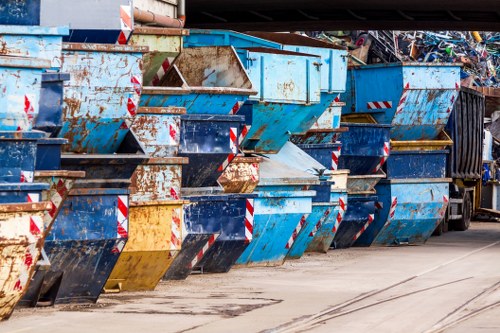 Commercial Waste Greenhithe provides an eco-friendly waste disposal area approach tailored to businesses across the Thames Estuary corridor. We focus on creating a practical, resilient and measurable pathway to a low-carbon marketplace for local firms and estates. Our work balances day-to-day operational needs with ambitious environmental outcomes, and it sits alongside borough initiatives that emphasise clear waste separation at source to improve recycling rates.
Our services for Greenhithe commercial waste prioritise reusable materials, correct segregation and diversion from landfill. In partnership with local authorities and the boroughs we serve, collections are adapted to match kerbside schemes that separate glass, paper, mixed recycling, food waste and residual waste. Strong collaboration with council programmes reduces contamination and helps businesses navigate the boroughs' approach to waste separation.
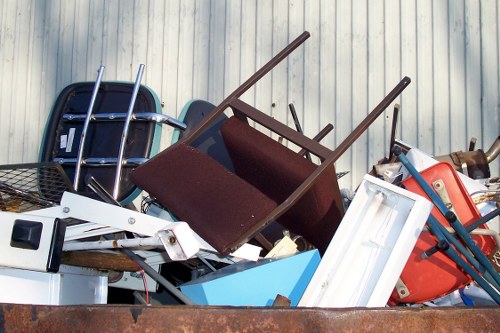 We have set a clear target for recycling performance: a recycling percentage target of 70% for all commercial accounts by 2030, with interim milestones of 55% by 2026 and 63% by 2028. This target reflects the shift from simple rubbish removal to creating a sustainable rubbish area at every site we serve — from industrial estates to retail parks — by improving segregation, storage and onward processing.
To support these targets we coordinate with local transfer stations and recycling centres that handle separated streams efficiently. These include nearby municipal transfer stations and regional materials recovery facilities that accept dry mixed recycling, food organics, bulky waste and construction & demolition materials. Using local transfer stations reduces vehicle miles, shortens handling time and keeps the carbon footprint low for each tonne processed.
Partnerships and Reuse Networks
Our reuse-first policy connects commercial customers with accredited partners and charities. We prioritise donation and redistribution for items that remain usable — furniture, appliances, textiles and surplus stock — diverting them to local charities, social enterprises and community reuse hubs to extend life cycles and support vulnerable households.Key elements of our charity partnerships include:
- Furniture and appliances: routes to local reuse charities and community stores
- Textiles and uniforms: collection and sorting for resale or recycling
- Food surplus: rapid redistribution to food banks and community kitchens
We maintain strict auditing to account for diverted tonnage and social impact. Monthly reporting shows material flows — volumes donated, recycled, composted and sent for recovery — so businesses can evidence progress against sustainability goals. Our monitoring aligns with the boroughs' waste separation policies and helps businesses report on reduced residual waste and increased recycling within their environmental management systems.
Low-Carbon Fleet and Route Optimisation
Our fleet strategy is integral to becoming an eco-friendly waste disposal area. We operate a growing number of low-carbon vans and vehicles — electric light commercial vehicles (EV LCVs), hybrid collection vehicles and Euro 6 compliance where EVs are not yet suitable. Combined with route optimisation software and consolidated pickups we reduce emissions, noise and traffic impacts for local communities.Telematics and driver training deliver tangible savings: lower idling, fewer empty runs and better load planning. Those operational improvements, coupled with shorter transfers to local stations, help lower the embodied emissions associated with each tonne of commercial waste managed in Greenhithe and surrounding boroughs.
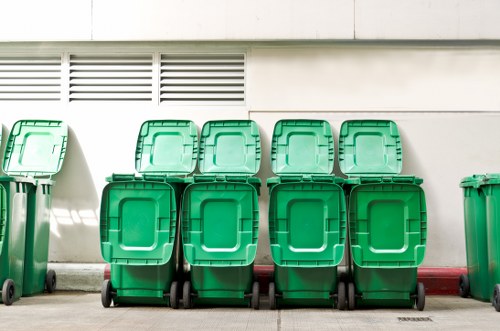
Our on-site support emphasises practical steps to create a sustainable rubbish area: clear signage, colour-coded containers, compacting where appropriate, and segregated storage for hazardous or specialist materials. These measures increase capture rates for recycling streams and reduce contamination rates, which directly supports our recycling percentage target and customer sustainability commitments.
We also offer bespoke waste plans for different sectors. Retail and hospitality clients receive guidance on food waste and packaging separation; construction and trades benefit from dedicated skips for inert materials and timber; offices are supported with paper, cardboard and IT equipment take-back schemes. All plans are designed to integrate with local authorities' kerbside schemes and transfer station acceptance criteria.
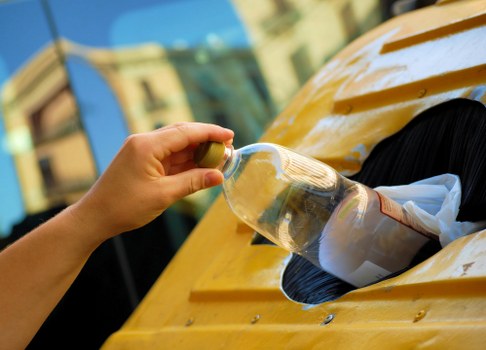 Community and Circular Economy — creating closed-loop outcomes is central to our mission. By channeling materials to remanufacturers, recyclers and social enterprises we increase local recycling throughput and stimulate markets for secondary materials. Small adjustments at the source — a better box for cardboard, a clear bin for glass — multiply upstream benefits and strengthen the circular economy that local businesses rely on.
 Finally, our approach is built around measurable improvement: regular reviews, performance dashboards and shared targets with customers and partners. We encourage businesses to set internal KPIs that align with our eco-friendly waste disposal area ambitions and to celebrate progress when diversion increases and fleet emissions fall.
Choosing an organised, sustainable rubbish area solution for Greenhithe means committing to better separation, smart logistics and community-minded reuse. With local transfer stations, strong charity partnerships, a low-carbon van fleet and an explicit recycling percentage target, Commercial Waste Greenhithe helps organisations transition from disposal to resource management.
Get involved by reviewing your current waste streams, mapping potential reuse opportunities and working with providers that prioritise low-carbon transport and verified recycling routes. Together we can build resilient, efficient and greener waste systems that serve businesses, residents and the environment across the boroughs.
